Independent AI Evaluation & Assurance
Prove your AI systems are safe, fair, and compliant — with evidence, not assertions. We test AI systems, assess governance controls, and produce audit-ready assurance mapped to the frameworks that matter to you.
AI adoption has outrun AI assurance
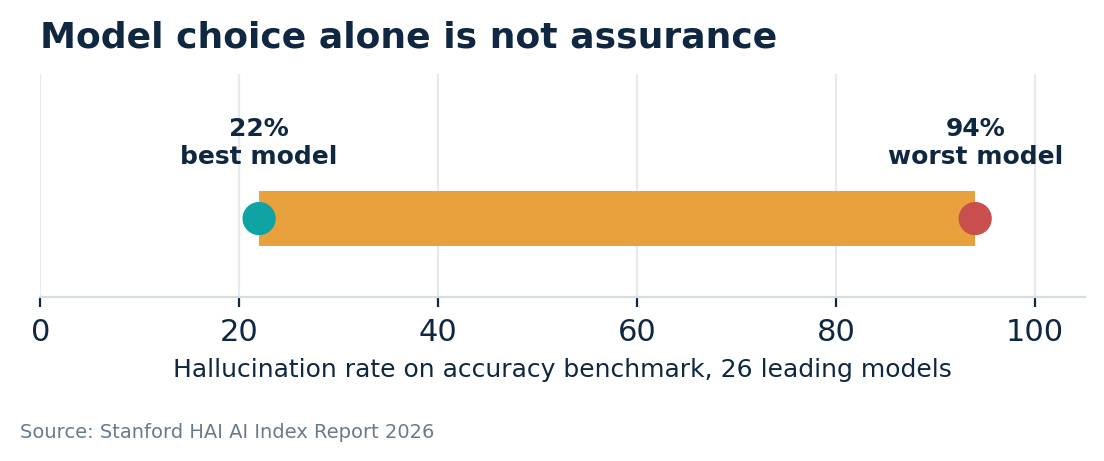
Organisations are deploying AI faster than they can govern it. The gap between deployment and assurance is where incidents, regulatory exposure, and reputational damage now originate. Only testing against your use case, your data, and your users tells you where your systems actually sit.
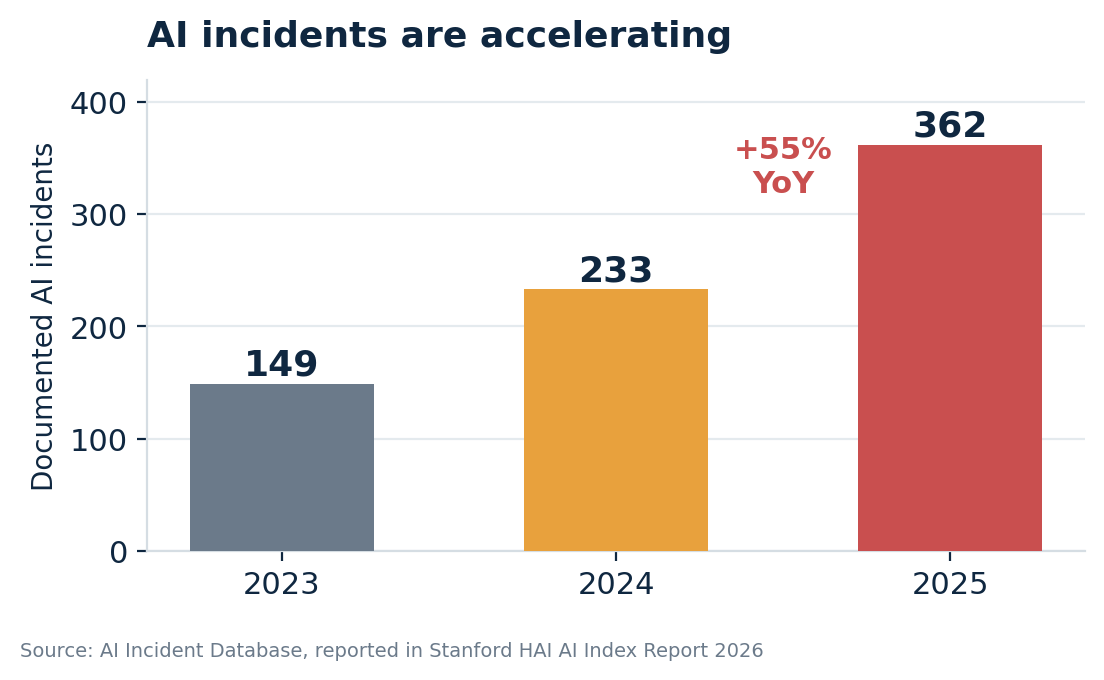
documented AI incidents in 2025 — up 55% year on year
Stanford HAI, AI Index Report 2026
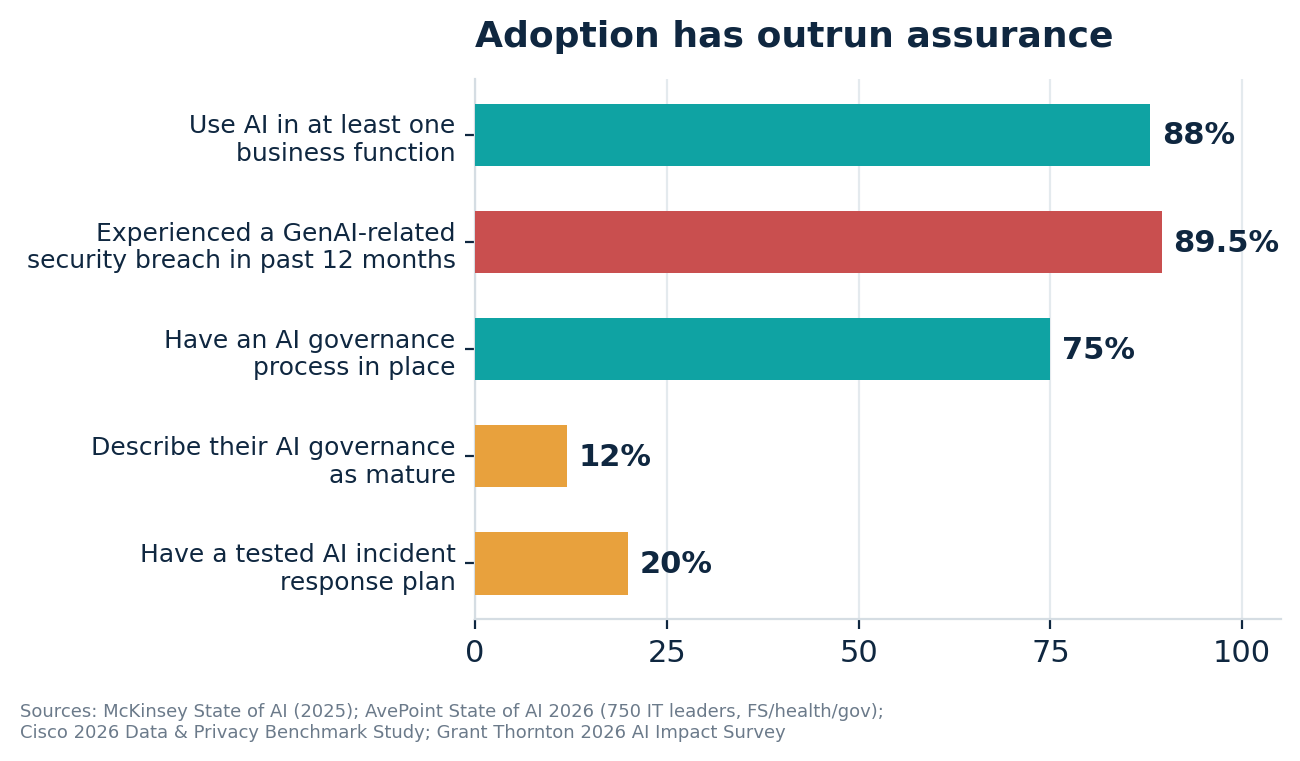
of organisations experienced a GenAI-related security breach in the past 12 months
AvePoint, State of AI 2026
of organisations describe their AI governance as mature
Cisco, 2026 Data & Privacy Benchmark Study
Regulators are closing the assurance gap
Most organisations now have an AI governance process on paper. Very few can show a working one. None of the emerging frameworks are satisfied by a policy document — they all point the same direction: demonstrated, evidence-based assurance that AI systems have been tested and are governed.
Australia's AI Safety Institute
Established under the National AI Plan with $29.9M in funding and operating from early 2026, signalling a national focus on testing and evidence for AI systems.
Voluntary AI Safety Standard (10 guardrails)
The de facto benchmark for responsible AI in Australia, with testing, transparency and accountability at its core.
ISO/IEC 42001
The first international AI management system standard, increasingly requested in procurement and due diligence.
Sector regulators
APRA-regulated entities face model risk and operational resilience expectations (CPS 230/234); higher education providers face growing TEQSA scrutiny of AI in academic contexts; government AI assurance frameworks are shaping procurement.
Independent AI evaluation and assurance
Testing combines automated adversarial evaluation, curated test datasets aligned to your risk profile, red-team exercises, and structured human review — run against your live endpoints or in controlled environments, with evaluation depth proportionate to each system's risk tier.
| Dimension | What we test |
|---|---|
| Safety | Hallucination and groundedness, harmful content, incorrect or dangerous advice, appropriate escalation |
| Security | Prompt injection, jailbreak resistance, system prompt extraction, data exfiltration, context poisoning |
| Fairness | Bias across demographic and cohort scenarios relevant to your users; equal treatment and stereotyping analysis |
| Privacy | Personal data leakage, memorisation, sensitive information extraction |
| Quality | Accuracy benchmarking, response consistency, citation correctness, latency and cost under load |
| RAG performance | Faithfulness, answer relevancy, context precision and recall for retrieval-augmented systems |
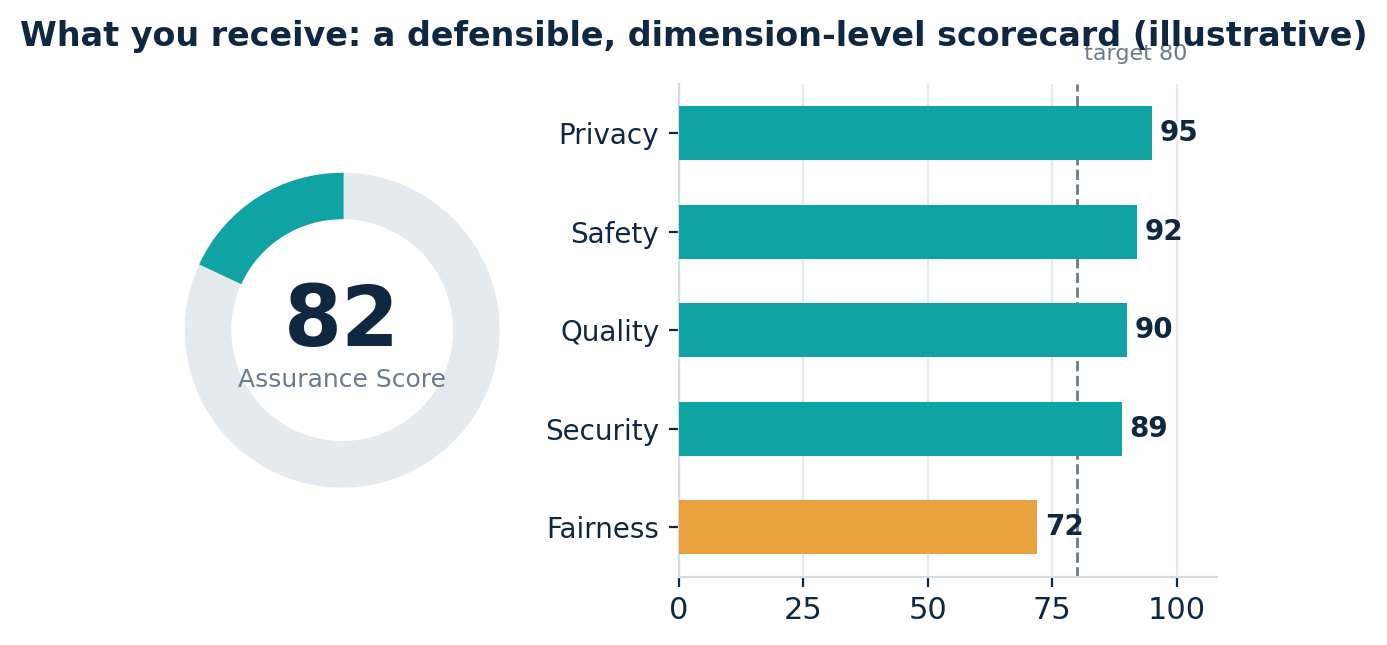
What you receive: a defensible, dimension-level scorecard
Every engagement produces a defensible evidence package: methodology, test configurations, results, control verdicts, findings by severity, and remediation recommendations — with full provenance, so the assessment can be reconstructed and defended in a review years later.
Three ways to work with us
Independence, protected by design. Where we have embedded with a build team, independent evaluation of that same system is delivered under a documented separation protocol — and we will tell you plainly when a fully external evaluator is the more defensible choice.
Embedded Evals Engineering
We build your evaluation capability inside your engineering team.
- Design and implement evaluation frameworks fit for your stack — test harnesses, golden datasets, adversarial suites, scoring rubrics and regression baselines
- Build evals-as-code: evaluation suites running in your CI/CD pipeline, gating deployments the way unit tests gate releases
- Stand up continuous evaluation in production — drift detection, failure-pattern monitoring, automated re-testing on model or prompt changes
- Upskill your engineers through paired build, documented patterns and structured handover — the capability stays when we leave
Best for: Product and platform teams building customer-facing or decision-support AI. Typically 8–16 weeks per squad.
Independent Evaluation of Internal Builds
Arm's-length assurance for the AI you've built.
- Risk-proportionate evaluation plan, agreed and transparent before execution
- Independent technical evaluation and red-team exercises — automated adversarial testing, curated datasets, structured human review
- Control and evidence assessment against ISO/IEC 42001, Australia's AI Safety Standard, NIST AI RMF, and APRA or TEQSA sector overlays
- Defensible assurance report: scores, control verdicts, findings by severity, residual risk, prioritised remediation path
Best for: Pre-deployment approval, periodic re-assurance of high-risk systems, incident-triggered review. Typically 3–6 weeks per system.
Vendor & Platform Evaluation
Independent evals on the AI you're about to buy — before you're locked in.
- Evaluation criteria defined from your use cases and risk profile — not the vendor's feature list
- Structured, like-for-like evaluation of shortlisted vendors: accuracy on your domain, safety behaviour, security posture, bias on your user cohorts, cost and latency under realistic load
- Evidence-based vendor comparison for procurement and risk teams, including contractual controls to demand
- Post-deployment verification and re-evaluation aligned to vendor release cycles — vendor platforms change under you with every model update
Best for: AI platform selection, copilot and embedded-AI SaaS procurement, renewal decisions, third-party AI risk programs. Typically 4–8 weeks per selection cycle.
How an engagement works
Internal teams are close to their systems — that is their strength and their blind spot. Independent evaluation gives your governance bodies something internal sign-off cannot: assurance that does not depend on the people who built the system marking their own homework.
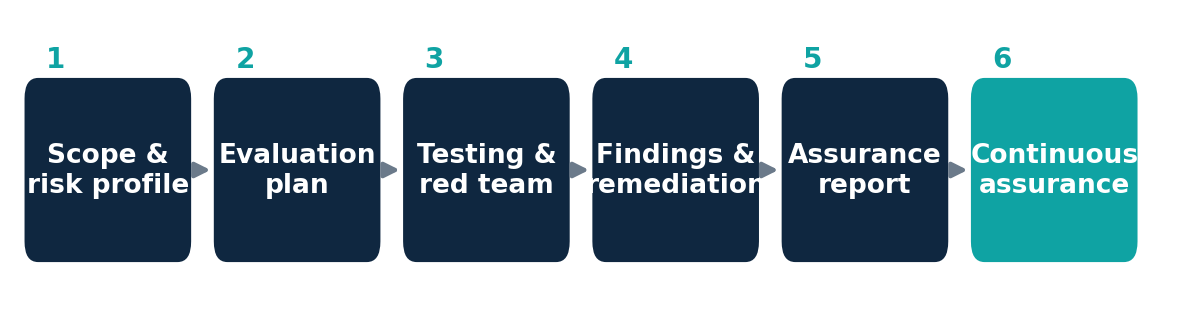
Scope & risk profile
We register and profile your AI systems — use case, users, decision impact, data sensitivity, autonomy — determine risk classification, and agree the applicable frameworks and evaluation depth.
Evaluation plan
You receive a transparent test plan before execution: mandatory tests driven by your system's risk profile, plus contextual tests targeting your specific use case. No black boxes.
Testing & red team
We execute technical evaluations, adversarial red-team exercises, and control assessments — with progressive visibility of results as they land, not a single reveal at the end.
Findings & remediation
Every failure becomes a tracked, prioritised finding with a severity rating, a clear owner, and a recommended fix — not a PDF that sits in a drawer.
Assurance report
A board- and regulator-ready report with scores, control breakdowns, residual risk and an improvement roadmap — expressed in the language your governance bodies use, whether that's a model risk committee, an ethics committee, or a regulator.
Continuous assurance (optional)
Periodic re-evaluation to catch drift, model updates and new failure patterns — so assurance stays current rather than expiring the day the report is issued.
Built for regulated sectors
Financial services
APRA-regulated entities using AI in customer-facing and decision-support contexts — where model risk, CPS 230/234 obligations and board accountability require evidence-based AI governance.
Government & regulated enterprise
Organisations subject to AI assurance frameworks and procurement requirements that expect independent testing and documented governance.
Higher education
Universities deploying AI tutors, advisors and student-facing assistants — where academic integrity, student equity and TEQSA expectations demand demonstrable assurance before and after deployment.
What you can expect from us
Technical depth. Real evaluation engineering — adversarial test suites, RAG metrics, CI/CD-integrated eval gates — not questionnaire theatre.
Regulatory fluency. Findings mapped to ISO/IEC 42001, Australia's AI Safety Standard, NIST AI RMF, and your sector's regulatory overlays.
Full provenance. Every conclusion traceable to the tests, evidence and decision logic behind it — built for audit defence.
Straight answers. If a system should not deploy yet, we will say so — and show you exactly why, and what to fix.
Start with a scoping conversation
A 45-minute session to map your AI systems, risk profile and regulatory context — and identify which engagement model fits. No obligation.
Sentrify Advisory provides independent evaluation and assurance services. We are not a certification body, law firm, or registered auditor, and our reports do not constitute legal advice or formal certification against any standard. Market statistics cited are drawn from third-party published research as referenced; illustrative scorecards do not represent any actual client system.